Showing posts with label Economy. Show all posts

1/02/2025

10 Trends to Watch in 2025: Insights from Tom Standage

10 Trends to Watch in 2025, Inspired by Tom Standage’s Insights 1-America First Redux Geopolitical shifts will unfold as the U.S. doubles down on its "America First" policy. 2-A Call for Change Macro-political transformations are imminent, driven by demands for reform in nearly every major election of 2024. 3-Heightened Instability in Europe and the Middle East A transactional approach from the new U.S. administration could exacerbate tensions in these regions. 4-The Tariff Tsunami Expect more tariffs, with ripple effects on global trade and economic growth. 5-The Clean-Tech Boom China's advancements in clean technology could revolutionize the energy sector worldwide. 6-Inflation and Fiscal Tightening Most economies are gearing up for stricter fiscal policies, raising questions about growth and voter approval. 7-The Politics of Aging Could age limits for political leaders become a global trend? 8-AI Revolution Agentic AI systems are poised to become the most transformative innovation since the internet. 9-Tourism Backlash The pushback against overtourism will reshape the travel industry. 10-Expect the Unexpected From global pandemics to solar storms, the world must brace for unpredictable disruptions. Stay tuned for a deeper dive into each of these trends in the near future. (text revised by a LLM) Tom Standage’s ten trends to watch in 2025 https://www.economist.com/the-world-ahead/2024/11/18/tom-standages-ten-trends-to-watch-in-2025 From The Economist

- Pedro

Read on Substack

11/30/2024

Global Ripples: Preparing for the Economic Impact of Tariffs in 2025

The saying goes, “A picture is worth a thousand words.” By analogy, a cartoon—especially one from Kal—is worth 100^{10} words. The tariffs are expected to fuel inflation in the U.S. economy, spark a trade war with no clear winners—least of all the American consumer—and create ripple effects across the globe, impacting regions such as China and Europe. However, this is no longer a question of if it will happen, but rather how significant the impact will be and how it will affect your region and industry. Have you factored this reality into your 2025 macro scenario? If so, what decisions have you made in response? (text revise by a LLM) The weekly cartoon https://www.economist.com/the-world-this-week/2024/11/28/the-weekly-cartoon from The Economist

- Pedro

Read on Substack

11/25/2024

Dos horas con Javier Milei: Desafiando paradigmas y repensando lo público

Un podcast muy interesante que desafía el status quo en el que vivimos, con Javier Milei, Presidente de la República Argentina. Es un verdadero placer escuchar a un presidente con profundos conocimientos de economía, probablemente la ciencia social más relevante cuando se trata de gestionar lo público. Milei presenta una visión clara de lo que quiere lograr y cómo planea hacerlo. Estoy de acuerdo con muchas de sus ideas (en temas como economía, desregulación y el rol limitado del Estado en funciones que no le son inherentes), aunque discrepo en otras. Independientemente de lo que se pienses sobre Milei, creo que vale la pena invertir dos horas en escuchar este podcast. (texto revisado por un LLM) https://youtu.be/8NLzc9kobDk?si=3qjmHf2d_No1ZHKM

- Pedro

Read on Substack

10/21/2019

O-Ring Theory of Development and its importance on a company organization, HR, output & wages


Came across this economic theory by chance (on the Marginal Revolution Blog - Tyler Cowen and Alex Tabarrok) and it was surprisingly insightful, simple and helped to structure my line of thought on the areas of: Management, Organization setup and the importance of Areas of Excellence within an organization. 

Additionally, it also explains the pay gap between excellent (A-players) and very good & below associates (B/C/D - Players).

I strongly advise you to see the video of 19 minutes that provides a great overview of this theory (so you can also understand the math).

So the O-Ring Theory of Development (Michael Kremer, 1993) is underpinned by the following assumptions:
  1. Production (broad sense) depends on completing a number of tasks;
  2. Failure or quality curtailment of any task reduces the entire product (weakest link problem);
  3. Quantity cannot substitute quality (2 mediocre Finance Directors will not do a better job than a great Finance Director)
If you take a broad approach to this production function you have a company or even an entire economy.

Main practical deliverables of such theory:
  • Quality matching - you should put your high quality workers together (preferentially allocated to the company areas of excellence, based on its value chain) and the other workers (B/C) also together, instead of mixing them up, as the results will be significantly better;
  • Higher quality it will imply better results (i.e. better outputs)
  • Higher outputs/results will result in better wages (macroeconomics 101) for any organization & that the function Output/Wages is not linear
  • The wage distribution is severely skewed to the right and the talent distribution follows a normal distribution (that is why small incremental talent on the top decile can have a significant impact on the associates wages);
  • Workers performing in high-skill firms will have higher wages than low-skill firms (look at the wage gap of tech/pharma companies compared with other industries);
  • Talent attracts Talent - High quality worker will want to work with other of the same standards (virtuous cycle)
  • There is an tremendous incentive to invest in skills/quality of the workers (company and and associates)
  • This theory has several "equilibria", meaning that if your are surrounded by high quality workers it pays-off to invest in becoming one, but if you are within a non-high quality organization it does not pay-off to invest, as your higher potential output will be severely curtailed by the others;
  • Capital will be allocated to high quality organizations or within the organization to the areas with the highest quality potential - so if you are investing within your organization make sure you have your A-team on that area.
You can think your organization is performing several activities throughout your value chain, thus applying this theory you can identify bottlenecks, linkages and complementarities and don't forget where are your areas of excellence based on the Value Proposition so you can have your A-players on it!


10/19/2019

IMF - Europe 18/10/2019


IMF - Europe 18/10/2019 takeaways:

  • Slowdown across advanced Europe from 1,4% to 1.3% specially in Germany, Italy and UK, due to trade tensions and Brexit. 2020 modest recovery of the grwoth rate to 1,5%;
  • Demand is strong and it's underpinned by a strong labor market;
  • Fiscal policy should be used for the countries with potential expansionary policy slack (Germany / Netherlands) however there are countries that still should be focusing on fiscal consolidation (southern countries);
  • Monetary policy should be accommodative as is being implemented by ECB to avoid a recession, however such policy is depletive of potential future monetary policies;
  • Emerging Europe is also reducing its growth prospects, still expected to grow at 3,7% and on 2020 at 3,1%;
  • Long-term problems remain - productivity and demographics in advanced Europe should be addressed and  Emerging Europe should improve macro-economic policies to tackle structural problems and promote institutions reforms & its governance k«


10/18/2019

World Economic Outlook, October 2019 - IMF - Synchronized Slowdown


IMF published on October, 15th 2019 the World Economic Outlook, that reinforces the projections of a synchronized slowdown for the world economy.

My key takeaways:
  • 2019 growth rate at 3% for 2019 (below PIIE forecast) and 3,4% for 2020 vs. 3,8% in 2018 due to trade barriers, low productive growth and aging demographics in advanced economies; 
  • Advanced economies should slowdown to 1,7% and converging to their potential;
  • Downside risk to this projection has significantly increased (trade barriers, geopolitical tensions and Brexit)
  • 2020 is expected to go at a slighter better pace driven by emerging markets and base effect, i.e. that global trade activity and manufacturing is so slow in 2019 that 2020 is just picking-up to normal values resulting in a increase of the global growth;
  • No recession is foreseen for the next 12 months;
  • Trade tensions between US/China (self-inflicted) produced a toll of 0.8% on the world economy,
  • Monetary easing in the main economies (USA/EU) is providing a tail wind to the world economy by 0,5%, although it creates additional risks as this preemptive accommodative monetary policy reduce space to fight a potential future recession
  • If world economic growth drops to 2,5% it would imply that several advanced economies would be in a recession, thus there is no space to policy missteps;
  • Monetary policy cannot not be the only answer to offset this downward trend and fiscal policy should be brought into the game in countries with budget space to accommodate such expansionary policies

World Economic Outlook, October 2019 - IMF

10/15/2019

O Crescimento Económico Português: Uma Visão sobre Questões Estruturais, Bloqueios e Reformas


Um livro que lerei no mais curto espaço de tempo para poder obter um retrato estrutural da economia portuguesa (perspetiva da oferta).

Logo que o tenha feito apresentarei um pequeno resumo com as principais ideias/conclusões que retive da sua leitura.

Para quem tenha interesse poderá obter o ebook no link infra.

Mais uma excelente iniciativa do Banco de Portugal

O Crescimento Económico Português: Uma Visão sobre Questões Estruturais, Bloqueios e Reformas

Relantización (significantiva) de la economia Española - Update 10/2019 CÍRCULO DE EMPRESARIOS


El Circulo de Empresarios ha presentado hoy su actualización de Octubre sobre la economía Española, demostrando una fuerte desaceleración (la tercera mayor de los países de OCDE).

Basado en esa información ha revisto en baja sus previsiones para el crecimiento de 2019 y 2020 significativamente, fruto de una desaceleración de la demanda interna,

Para obtener más información os aconsejo la consulta del update integral de su publicación (link abajo)


ASÍ ESTÁ… LA ECONOMÍA OCTUBRE 2019 - CÍRCULO DE EMPRESARIOS

10/13/2019

Global Economic Prospects: Fall 2019 - PIIE

Global Economic Prospects: Fall 2019

Global slowdown & risk of recession increasing, although not foreseeable for 2020
 Key takeaways:
 - US hit by the fade out of the fiscal stimulus sugar high & trade war impacting overall economy;
 - US evolving to potential (1,8% growth rate)
 - Fed should cut at least 1 more interest rate (probability of BS expansion to resume) - this supported by overall economy (see presentation on US monetary policy)
 - Europe sluggish growth 1% as global trade is stalling specially impacting Germany and Italy based on internal unbalances;
 - Brexit impact already kicking-in with negative consequences (Hard Brexit would make the picture even worse)
 - Potential growth for Europe 1.5% (above forecasts)
 - China 6% growth new normal
 - Japan better than previously expected 0,8%
- Brazil speeding up, but still very contained growth

the 3 presentations bring more color and the conference more insights!


Projeções para a Economia Portuguesa 2019

1/13/2019

Review: The General Theory of Employment, Interest, and Money

The General Theory of Employment, Interest, and Money The General Theory of Employment, Interest, and Money by John Maynard Keynes
My rating: 2 of 5 stars

From an economic standpoint it was a book that disclosed several new ideas and concepts that challenged the accepted body of knowledge (classical perspective) related with unemployment, interest and money. Made me think about the classical point-of-view on these subjects and what you still learn in economy classes (as an university freshman) and has enriched the discussion on subjects at hand. Gave a multidimensional perspectives to problems that were previously considered in a simplistic way. It also presents the basics for behavioral economics relevance on the daily economic decisions, a topic so trendy these days

The problem is that most policy makers when defining policies in these areas stay with the 101 classical perspective and do not take a more holistic approach, whereby a multi-factor variables and potential impact should be considered.

Do not advise it for someone that does not have the basic/medium economic knowledge, his writing is not the most exciting one, the structure of the text, within the chapters, does not help, thus i must confess that i struggled to finish it (having stopped and restarted its reading several times did not help neither). Will let this book rest for a couple of months and eventually will come back to it to see if i can take advantage of its insights (that are undeniable) in a better way.

Do not recommend this Kindly version, several typos and also a missing important chart.

View all my reviews

9/16/2018

Review: CFA Program Curriculum 2017 Level II, Volumes 1 - 6

CFA Program Curriculum 2017 Level II, Volumes 1 - 6 CFA Program Curriculum 2017 Level II, Volumes 1 - 6 by CFA Institute
My rating: 4 of 5 stars

Excellent curriculum books on the subjects/topics under study

Ethical & Professional Standards,
Quantitative Methods
Economics
Financial Reporting and Analysis
Corporate Finance
Equity
Fixed Income Derivatives
Alternative Investments
Portfolio Management

View all my reviews

5/01/2018

Review: Nudge: Improving Decisions About Health, Wealth, and Happiness

Nudge: Improving Decisions About Health, Wealth, and Happiness Nudge: Improving Decisions About Health, Wealth, and Happiness by Richard H. Thaler
My rating: 3 of 5 stars

Easy and nice read on behavior economics (specially for non-economists), with good takeaways, insights and useful advice ...from 2/3 of the book onwards slightly repetitive as the thesis, associated concepts were already duly presented and explained.

Do recommend its reading if interested on the subject!

View all my reviews

Review: Thinking Strategically

Thinking Strategically Thinking Strategically by Avinash K. Dixit
My rating: 3 of 5 stars

Good introduction to the game theory topic (my rating would be 3.5)

You can clearly date the book based on the examples given, but nonetheless worthwhile Reading. Sometimes the cases are too simple and sometimes, in a couple of exemples, the rationale is not presented clearly that obliges the reader to go back and forth in the books pages to grasp it.

For all interested in the subject (that should be at least every economist, financier or manager), opens the door to this important topic that will allow you to make better and more informed strategic or even tactic decisions.

View all my reviews

8/28/2012

Execução orçamental e a “Curva de Laffer”


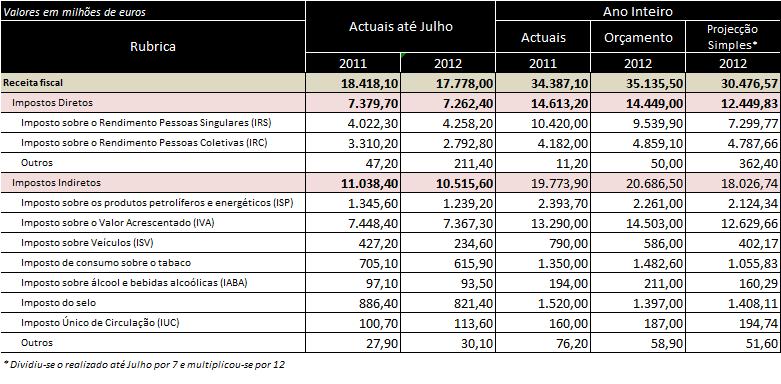
No passado dia 23 de Agosto, foi publicada pela Direcção Geral do Orçamento a “Síntese da Execução Orçamental” de 2012 actualizada a Julho.

As notícias não são de todo as melhores, pois existe um forte (para usar um eufemismo) desvio, na ordem dos €3.5 mil milhões de euros, entre as receitas correntes que estão previstas no Orçamento de 2012 e o valor que se prevê arrecadar até ao final do ano.

 Os principais desvios na receita fiscal podem ser consultados no quadro infra:


                                                       Quadro 1 - Receitas Fiscais 2012 

Fonte: Sintese da Execução Orçamental Agosto 2012

Este desempenho impossibilita, conforme já foi reconhecido pelo Ministério das Finanças, o cumprimento da meta para o défice orçamental em 2012, que tinha sido apresentada e aprovada no Parlamento Português e acordada com a UE, FMI e BCE (Troika).

É claro que caso sejam tomadas medidas adicionais de austeridade que compensem este desvio, a meta  definida (4,5% do PIB) ainda poderá ser alcançada. Contudo, tais medidas (quer do lado da receita, quer do lado da despesa) serão muito difíceis de implementar em tempo útil e agravariam o nível de contracção da actividade económica em 2012 (no futuro apresentarei o impacto negativo que o aumento de impostos traz a qualquer economia).

Acredito que a maioria tenha ficado surpreendida e apreensiva com esta performance, pois o orçamento para 2012 implicou um aumento significativo da carga fiscal sobre todos os agentes económicos (famílias e empresas), quer seja em termos dos impostos sobre o consumo (aumento do IVA), quer seja sobre os impostos sobre o rendimento e capital (aumento das taxas de imposto e redução dos benefícios fiscais) e o valor arrecadado pelo Estado é substancialmente inferior ao definido no Orçamento e mesmo ao obtido no ano anterior.

É aceite por todos que a evolução da receita corrente do Estado está indissociavelmente dependente do desempenho da economia. Todavia, nem esta situação pode ser apresentada como pretexto para tão fraco desempenho vs. o Orçamento, pois a contracção da economia está quase em linha com o estimado no orçamento de Estado (2,8% no Orçamento vs. 3,0% a 3,2% nas projecções actualizadas apresentadas por diversas instituições), logo as receitas foram estimadas tendo por base um cenário não muito diferente daquele em que actualmente nos encontramos (existem variações na composição do PIB, em especial na procura interna que é compensada pela procura externa, que poderão explicar em parte o desvio).

Então o que correu mal?

Acredito que só quem elaborou o orçamento poderá responder de uma forma cabal a tal pergunta, tendo por base os pressupostos utilizados, contudo uma das hipóteses para explicar tal situação é que o próprio aumento da carga fiscal, que já de si tem um efeito recessivo na economia, tenha tido um efeito contrário ao pretendido, i.e. o seu aumento implicou uma redução efectiva da receita total obtida.

Este fenómeno pode ser explicado e facilmente percebido pela observação da Curva de Laffer (criada pelo economista Arthur B. Laffer). 

                                                            Figura 1 - Curva de Laffer


O gráfico supra apresenta na ordenada (linha vertical) a receita corrente obtida e apresenta na abcissa (linha horizontal) a taxa de imposto associada.

De forma a facilitar o seu entendimento, este gráfico poderá ser lido da seguinte forma:

 - Para uma taxa de imposto de 5% a receita fiscal será de 175 unidades monetárias (ponto A).

Como se pode constatar, à medida que a taxa de imposto sobe (movimento da esquerda para a direita na abcissa), a receita fiscal também aumenta. Contudo, este crescimento tem um limite e há um determinado ponto em que o aumento da taxa de imposto faz reduzir a receita fiscal global (ponto de inflexão da curva - ponto B).

Este fenómeno é de fácil compreensão se o aplicarmos aos impostos sobre o rendimento (IR). Assim, caso a taxa de imposto sobre o rendimento seja 0% não existirá qualquer receita fiscal e o rendimento ficará na sua totalidade para o gerador do rendimento (pessoa singular ou colectiva). Contudo, caso a taxa de imposto seja 100% muito dificilmente existirá receita fiscal, pois não existirá qualquer incentivo económico para se realizar/gerar tal rendimento já que ficaria na sua totalidade para Estado (a pessoa singular ou colectiva estaria a trabalhar para o Estado).


Deste modo, o ponto óptimo, na perspectiva do Estado para aumentar a sua receita, seria aquele em que se maximizasse o valor da receita fiscal (ponto B), ou pelo menos que tivesse muito perto desse ponto (e de preferência, por uma questão de prudência, posicionado do seu lado esquerdo).
  
Resulta desta realidade que à medida que vamos subindo a carga fiscal em Portugal, mais próximo estaremos do ponto de inflexão da curva e mais próximo estaremos do ponto em que o aumento da carga fiscal gerará um efeito contrário ao pretendido.


                                 Quadro 2 - Evolução da Carga Fiscal em Portugal
Fonte: INE & Banco de Portugal

Sinceramente, não sei se o ponto de inflexão já foi alcançado (talvez nalguns tipos de impostos, em especial nos impostos sobre o trabalho e consumo, estejamos muito perto do ponto de inflexão), mas esta realidade deverá ser tida em conta quando se tiver que tomar uma decisão sobre o aumento da carga fiscal na nossa economia para diminuir o défice do Estado Português, quer seja ainda em 2012, quer seja para o orçamento de Estado de 2013 (em especial tendo em consideração a recente decisão do Tribunal Constitucional).

O caminho, conforme o apresentado em diversos estudos empíricos, terá sempre de passar pela redução da despesa (pelo menos em 2/3) e não deverá passar pelo aumento de impostos, caso contrário não se consegue resolver o problema do défice a longo prazo e conforme o apresentado anteriormente até poderá ter um efeito pernicioso na resolução deste problema.


8/21/2012

Missão e Objectivos


Há já algum tempo, durante a minha actividade profissional, constato que a maioria dos meus colegas, clientes, fornecedores e outros agentes (stakeholders), detêm, em média, um nível de conhecimentos muito reduzido sobre o valor que as actividades secundárias (tais como: Gestão Financeira, Gestão do Capital Humano, Gestão Estratégica, Controlo de Gestão e Performance, Gestão dos Sistemas de Informação, etc...) podem e devem aportar a qualquer organização.

Na realidade, estas actividades são percepcionadas como um custo necessário e obrigatório e raramente são tratadas como uma fonte de valor acrescentado. Situação, que na minha opinião, delimita de uma forma substancial a capacidade operacional, económica e financeira de qualquer organização e consequentemente a economia como um todo (e que me levou a criar uma empresa que visa fornecer este tipo de serviços).

Adicionalmente e mais recentemente, em especial desde Setembro de 2008, todos nós somos expostos diariamente a um conjunto de conceitos e termos económicos e financeiros que a maioria não domina e não sabe do que se trata, mas que, percebemos e sentimos, têm um impacto directo na nossa qualidade e nível de vida. Existe, de facto, uma natural iliteracia económica e financeira por parte daqueles que não têm formação específica nestas áreas.

De forma a mitigar este défice de informação e conhecimento (promovendo uma espécie de intermediação de informação), quer seja a nível empresarial, quer seja a nível individual, decidi criar este blog que pretende ser um fórum onde possamos partilhar o conhecimento que cada um tem em determinadas áreas e dessa forma minimizar o diferencial de conhecimento e informação que actualmente existe.

A missão do blog “Prémio de Risco” é fomentar o conhecimento e divulgar de uma forma simples e directa conceitos básicos nas áreas de Economia, de Estratégia, de Finanças, de Gestão Financeira, de Mercados Financeiros e de Controlo de Gestão e Performance que acrescentem valor aos seus leitores.

Deste modo, pretendo publicar neste “fórum”, de uma forma regular, artigos/”posts “que permitam um debate construtivo sobre cada um dos temas e assuntos mencionados anteriormente.

Os objectivos que me proponho com este blog são: 
  •  Apresentar e explicar os conceitos associados aos Mercados Financeiros;
  •  Apresentar e explicar os conceitos e os impactos das políticas Macroeconómicas;
  •  Fomentar o conhecimento e o interesse pelas actividades secundárias;
  • Promover o intercâmbio de ideias e experiências dos participantes neste fórum;
  • Divulgar de uma forma regular artigos sobre cada uma das áreas de conhecimento em análise.