9/22/2024

And if you could predict a Tipping Point?

Tipping point definition- (i) the moment of critical mass, the threshold, the boiling point…[where] Ideas and products and messages and behaviors spread like viruses do or (ii) the point at which a series of small changes or incidents becomes significant enough to cause a larger, more important change. I would say that is the moment we stop being at a normal distribution and start seeing Power Laws in play and it is kind the holy grail for the prediction domain and applies from financial markets, economy evolution, book sales…. up to biology, After the fact everyone could see it :-), but no one could detect it before (and the ones who could…were lucky). At least up to now, as it seems some researchers in China were able to proof (study published in the Journal Physical Review X, that with the help of AI they could identify the tipping point ex-ante in complex systems. Unfortunately, as in many AI algorithms on the algorithm knows what specific features and patterns allowed them to identify the tipping points, being currently the work of the team to try to understand what those are. Nonetheless, something to keep your eyes on. AI can predict tipping points before they happen https://www.economist.com/science-and-technology/2024/07/17/ai-can-predict-tipping-points-before-they-happen from The Economist

- Pedro

Read on Substack
Five books recommended by the Economist that address the Glory and Flaws of the Olympics

Do you like Sports overall and the Olympics in particular? If yes, five books recommended by the Economist that address the Glory and Flaws of the Olympics to help you go through this 4-year hiatus. All added to my wish list. The Games: A Global History of the Olympics. By David Goldblatt. The Perfect Mile. By Neal Bascomb. The Amateurs: The Story of Four Young Men and Their Quest for an Olympic Gold Medal. By David Halberstam The Sports Gene. By David Epstein. Circus Maximus: The Economic Gamble Behind Hosting the Olympics and the World Cup. By Andrew Zimbalist https://www.economist.com/the-economist-reads/2024/07/11/five-books-on-the-glories-and-flaws-of-the-olympics

- Pedro

Read on Substack

HUD - Augmented reality offers a safer driving experience by the Economist

Head-up displays, are headsets that produces three-dimensional images that appear to be belonging to road ahead, thus provide clear information on navigation, vehicle performance, provide warnings, highlighting potential dangers resulting in safer and distraction-free driving. Its technological evolution throughout the years has been significant, but it is expected to pick up the pace in the near future (a potential demand CAGR of 24% until 2034). A technology to keep on your radar, at least until the full self-driving (level 5) cars are not a reality! An industry to be on my/your radar. Augmented reality offers a safer driving experience https://www.economist.com/science-and-technology/2024/07/24/augmented-reality-offers-a-safer-driving-experience from The Economist

- Pedro

Read on Substack

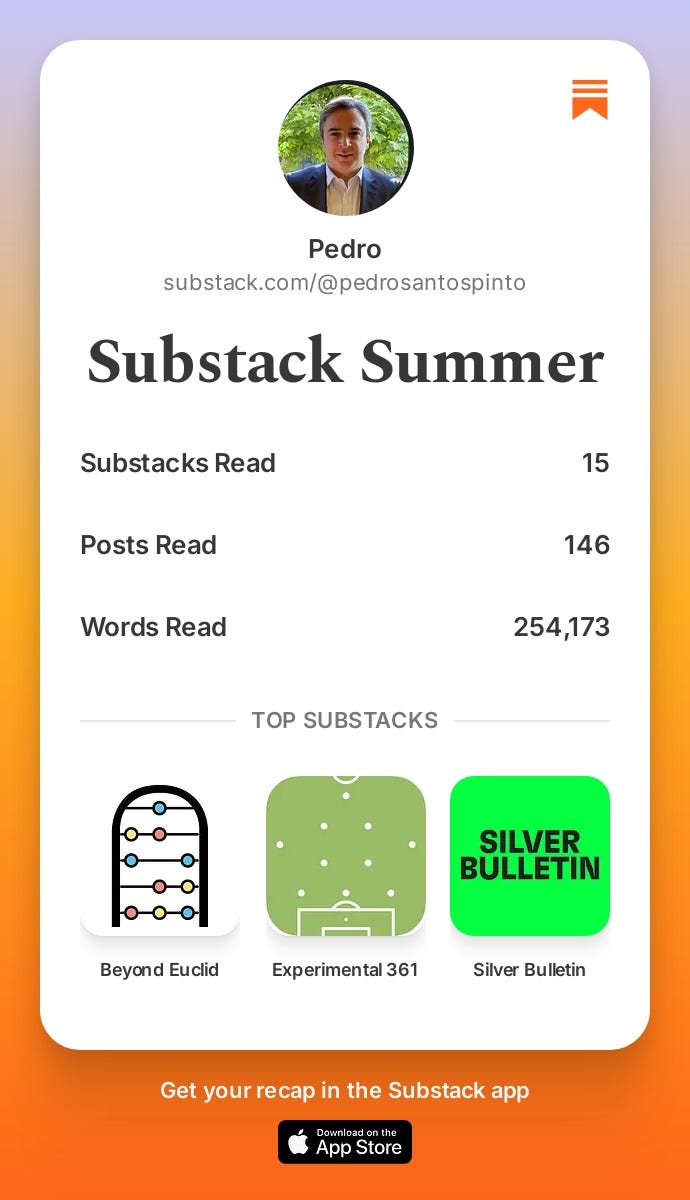
My Substack Summer

Highlights

☕ I read the most in the evening

💌 I subscribed to 5 new Substacks

📽️ I watched 140 minutes of video

❤️ I liked 4 posts

📜 I scrolled 11 meters in Notes

🕵️ I discovered 2 new posts via Notes

Top Substacks

Silver Bulletin by

Essays and analysis about elections, media, sports, poker, and all the other things I care about.

Top post this summer: We removed RFK Jr. from our model. But it didn’t hurt Kamala.

Beyond Euclid by

Beyond Euclid! A digital publication that brings you only the high-quality math and science stuff to ensure you are having a good week.

Top post this summer: Beyond Euclid - #133

Experimental 361 by

A continuation of the Experimental 361 blog and Twitter account, providing data visualisation and analysis of football.

Top post this summer: Squad churn: how recognisable will each team be this season?

Share your own Summer Recap

You can see your own summer recap in the Substack app. I’d love to see what you’ve been reading.

Get my Recap

Thanks for reading Risk Premium! Subscribe for free to receive new posts and support my work.


from Risk Premium https://ift.tt/dThBcpO
via IFTTT

9/21/2024

“Would you know, based on an educated model, what would be the range that the stock price of the company you work for should be priced?” - 96.96% would say no

Linkedin Poll on: “Would you know, based on an educated model, what would be the range that the stock price of the company you work for should be priced?” Out of the 345 persons (641 views) that saw this poll, only 9 voted :-) not a huge success, but a huge thank you to all the have voted. Although I would prefer having a bigger sample, will use Bayes' Theorem to update my beliefs and my conclusion is that 96.96% of respondents would say NO to the following question "Would you know, based on an educated model, what would be the range that the stock price of the company you work for should be priced?", based on the survey results... remember I started with a 90% baseline. Nothing like using this method in your simple problems so you can make it a habit while making your more important decisions! How did I arrived to the result: Baseline is: P(NO)=90% & P(YES)=10% After the survey i have observed that P(Survey|NO)=78% & P(Survey|Yes)=22% Thus, applying Bayes Theorem, the new probability of NO is: P(NO|Survey)= (P(Survey|NO)* P(NO)) / P(Survey) & P(Survey) = P(Survey|NO)*P(NO)+P(Survey|Yes)*P(YES) thus P(Survey) = (0.78*0.9)+(0.22*0.1)=0.724 thus P(NO|Survey) = (0.78*0.9) / 0.724=96.96%

- Pedro

Read on Substack

Do you love football? Would you like to take your knowledge to the next level?

Do you love football? Would you like to take your knowledge to the next level? Don’t miss this series by John Muller from the “The Athletic”. I can tell you I learnt much more than I was expecting, after being a huge football fan for almost half a century! “…In this ongoing series, John Muller takes a closer look at the mechanics of the game, one little piece at a time, comparing how different teams play — and why — to help make football make sense….” https://www.nytimes.com/athletic/5036774/2023/08/16/how-football-works-contents/

- Pedro

Read on Substack

The first six books of the elements of Euclid now available online by Harvard Library

The first six books of the elements of Euclid, with colored diagrams by Byrne was just made available by Harvard on Library (see below). This book is the “oldest math book” and of foundational relevance to mathematic as science (geometry). When Plato founded the Academy, back then the intellectual pinnacle of science, he engraved at its entrance “ΑΓΕΩΜΕΤΡΗΤΟΣ ΜΗΔΕΙΣ ΕΙΣΙΤΩ” (“Let no man ignorant of geometry enter.”) Below me, myself and I with the hard cover of this classic that I have in my library. https://iiif.lib.harvard.edu/manifests/view/drs:500797094$1i?utm_source=substack&utm_medium=email

- Pedro

Read on Substack