5/19/2024

8 Spy Novels Recommended by the Economist

8 spy novels recommended by the Economist. Bought to my library and all the other 7 added to wishlist. Happy readings! Tinker Tailor Soldier Spy → John le Carré “…The first part of John le Carré's acclaimed Karla Trilogy, Tinker Tailor Soldier Spy sees the beginning of the stealthy Cold War cat-and-mouse game between the taciturn, dogged George Smiley and his wily Soviet counterpart. A mole, implanted by Moscow Centre, has infiltrated the highest ranks of the British Intelligence Service, almost destroying it in the process. And so former spymaster George Smiley has been brought out of retirement in order to hunt down the traitor at the very heart of the Circus - even though it may be one of those closest to him….” From Russia, with Love → Ian Fleming “…Meet James Bond, the world's most famous spy.James Bond is marked for death by the Soviet counterintelligence agency SMERSH in Ian Fleming's masterful spy thriller, and the novel that President John F. Kennedy named one of his favourite books of all time.SMERSH stands for "Death to Spies" and there's no secret agent they'd like to disgrace and destroy more than 007. But ensnaring the British Secret Service's most lethal operative will require a lure so tempting even he can't resist. Enter Tatiana Romanova, a ravishing Russian spy whose "defection" springs a trap designed with clockwork precision. Her mission: seduce Bond, then flee to the West on the Orient Express. Waiting in the shadows are two of Ian Fleming's most vividly drawn villains: Red Grant, SMERSH's deadliest assassin, and the sinister operations chief Rosa Klebb - five feet four inches of pure killing power.Bursting with action and intrigue, From Russia with Love is one of the best-loved books in the Bond canon - an instant classic that set the standard for sophisticated literary spycraft for decades to come….” Tomás Nevinson → Javier Marías “…UNO DE LOS MEJORES LIBROSDE 2021 SEGÚN EL CULTURAL, BABELIA, EL MUNDO, LA VANGUARDIA, EL HUFFPOST Y GQ NOVELA GANADORA DEL PREMIO GREGOR VON REZZORI - CIUDAD DE FLORENCIA «Quizá sea la mejor de cuantas Javier Marías ha publicado hasta ahora.» José-Carlos Mainer, El País «Yofuieducado a laantigua, ynuncacreí que mefueran aordenar undíaquematara aunamujer. A lasmujeres no se lastoca, no se lespega, no se leshacedaño...» Dos hombres, uno en la ficción y otro en la realidad, tuvieron la oportunidad de matar a Hitler antes de que éste desencadenara la Segunda Guerra Mundial. A partir de este hecho, Javier Marías explora el envés del «No matarás». Si esos hombres quizá debieron disparar contra el Führer, ¿cabe la posibilidad de hacerlo contra alguien más? Como dice el narrador de TomásNevinson, «ya se ve que matar no es tan extremo ni tan difícil e injusto si se sabe a quién». Tomás Nevinson, marido de Berta Isla, cae en la tentación de volver a los Servicios Secretos tras haber estado fuera, y se le propone ir a una ciudad del noroeste para identificar a una persona, medio española y medio norirlandesa, que participó en atentados del IRA y de ETA diez años atrás. Estamos en 1997. El encargo lleva el sello de su ambiguo ex-jefe Bertram Tupra, que ya, mediante un engaño, había condicionado su vida anterior. La novela, más allá de su trama, es una profunda reflexión sobre los límites de lo que se puede hacer, sobre la mancha que casi siempre trae la evitación del mal mayor y sobre la dificultad de determinar cuál es ese mal. Con el trasfondo de episodios históricos de terrorismo, Tomás Nevinson es también la historia de qué le sucede a quien ya le había sucedido todo y a quien, aparentemente, nada más podía ocurrir. Pero, mientras no terminan, todos los días llegan...” Dead Lions. → Mick Herron “…In the Intelligence Service purgatory that is Slough House, where spies mockingly called the slow horses are sent to finish what is left of their careers, their boss Jackson Lamb is on his way Oxford. A former spook has turned up dead on a bus. Not an obvious target for assassination, Dickie Bow was a talented streetwalker back in the day. Good at following people, bringing home their secrets. Dickie was in Berlin with Jackson Lamb. Now Lamb's got his phone, on it the last secret Dickie ever told, and reason to believe an old-time Moscow-style op is being run in the Intelligence Service's back-yard. Once a spook, always a spook, and Dickie was one of their own. To unearth Dickie's dying secret Jackson Lamb and his crew of no-hopers is about to go live. …” 5.Damascus Station → David McCloskey “…IA case officer Sam Joseph is dispatched to Paris to recruit Syrian Palace official Mariam Haddad. The two fall into a forbidden relationship, which supercharges Haddad’s recruitment and creates unspeakable danger when they enter Damascus to find the man responsible for the disappearance of an American spy.Damascus Station …” Secret Asset → Stella Rimington “…From the former head of MI5 and bestselling author Stella Rimington comes the heart-stopping second novel featuring MI5 Intelligence Officer Liz Carlyle. When Intelligence Officer Liz Carlyle learns from one of her agents that suspicious meetings are taking place at an Islamic bookshop, she trusts her instinct that a terrorist cell is at work. Her boss, Charles Wetherby, immediately puts a surveillance operation into place. An attack seems imminent. So Liz is surprised when Wetherby suddenly takes her off the case. And she’s shocked to hear the reason why: he has received a tip-off that a mole is at work inside British Intelligence. If true, then the potential damage to the Service itself could be immeasurable. Now, as her colleagues scramble to avert a terrorist strike, Liz must find out who the mole is, and what their intentions are, before it is too late. …” Transcription → Kate Atkinson “…Dame Stella may know more than most novelists about tradecraft, but Kate Atkinson knows better than almost anyone how to write. In the superb “Transcription” Ms Atkinson has created a female lead for the ages. Juliet Armstrong is a perfect foil for the discreet, male-dominated world of espionage. Armstrong subverts her patronising superiors with humour and wit. “You have a good ear,” one spy chief tells her. “I have two, sir,” she replies brightly. Recruited at the beginning of the second world war by mi5, her job is to go undercover to penetrate Britain’s networks of posh Nazi sympathisers before they can harm the war effort. Aside from writing sparkling prose, Ms Atkinson also does her homework: overflowing with new recruits in 1940, mi5 really did move into Wormwood Scrubs prison. …” Our Man in Havana → Graham Greene “…Wormold is a vacuum cleaner salesman in a city of power cuts. His adolescent daughter spends his money with a skill that amazes him, so when a mysterious Englishman offers him an extra income he's tempted. In return all he has to do is carry out a little espionage and file a few reports. But when his fake reports start coming true, things suddenly get more complicated and Havana becomes a threatening place. …” https://www.economist.com/the-economist-reads/2023/11/24/eight-of-the-best-spy-novels?utm_medium=social-media.content.np&utm_source=linkedin&utm_campaign=editorial-social&utm_content=discovery.content.evergreen

- Pedro

Read on Substack
5/18/2024

Porqué el aleteo de una mariposa en Brasil puede desatar un tornado en Texas - Teoria del Caos

Un artículo muy interesante d’ El País que explica de una forma muy sencilla la origen y lo que es la teoría del Caos “…Todo sucedió cuando Lorenz tecleaba en su computadora un sistema para predecir el tiempo atmosférico. Iba introduciendo una serie de valores, cantidades para medir la dirección del viento, la humedad y la presión atmosférica, así como la temperatura, obteniendo una serie de resultados que —sorpresa— variaron cuando volvió a introducir de nuevo los datos. El pronóstico del tiempo ya no era igual, sino que era diferente al primero. Se debió a que la segunda vez, el programa de la computadora no redondeó las cifras, de tal manera que unas décimas, en apariencia insignificantes, provocaron grandes cambios. Dicho de otra manera: El aleteo de una mariposa en Brasil puede desatar un tornado en Texas. …” Es recomendado el libro “Caos” de James Gleick que tengo en mi librería, pero todavía no lo he leído (espero hacerlo este año). ! Buenas lecturas! Link del libro en Amazon → https://amzn.eu/d/aPouEQU https://elpais.com/ciencia/el-hacha-de-piedra/2024-04-25/por-que-pisar-una-mariposa-puede-traer-graves-consecuencias.html

- Pedro

Read on Substack

Una aurora boreal ilumina los cielos del mundo!

El pasado finde has podido presenciar una aurora boreal en algunas partes de España. Infelizmente yo no he podido verlo, pero en el link adjunto podrás ver algunas imágenes preciosas do que lo que se ha podido ver en todo el mundo. ¡Las auroras boreales son fenómenos que se pueden ver en regiones polares septentrionales, pero derivado de una gran tormenta geomagnética fruto de una actividad solar muy alta que solo pasa cada 10 a 12 años! ¡Disfrutad de las imágenes! https://elpais.com/ciencia/2024-05-11/una-aurora-boreal-ilumina-los-cielos-de-espana-y-podria-volver-a-ser-observable-este-fin-de-semana.html?autoplay=1

- Pedro

Read on Substack

5/17/2024

The silent flight of an owl - Natural World: Super Powered Owls

Nature at its best! How the flight of an owl does not produce any sound to a human ear and even the microphones detect a sound wave with an extremely low length/amplitude. Now the question is how they are able to be so silent? Something that I “need” to investigate https://youtu.be/-WigEGNnuTE?si=ZX0DXL8jdtc3HHL9

- Pedro

Read on Substack

5/16/2024

The Man Who Knew Infinity - Movie Recommendation

Great movie about the life of Srinivasa Ramanujan! Already heard a lot about him, but never knew his full story and it is something special to say the least. Highly recommend it. Hopefully you enjoy the movie as I did. https://youtu.be/LBvYjQvQB-k?si=uKVJSxmmK5NtTNoP https://www.primevideo.com/detail/0I5Q4TNZR7NVAN64CEEC1YZ3TD/ref=atv_dp_share_cu_r

- Pedro

Read on Substack

5/15/2024

Finalized Training -> Tackle the Hard Conversations with Radical Candor®

Finalized more than 1 month ago the MasterClass - Training with Kim Scott about Tackle the Hard Conversations with Radical Candor® (trailer below).

The more than 3 hours of content was a great investment and I have learnt a lot in an area that I definitely needed to improve my game.

I can only say that I really enjoyed the Sessions and made me think differently on how to tackle conversations throughout my personal and professional life (hard or soft), by following the 4 pillars of the Radical Candor framework:

  1. Get feedback,

  2. Give praise,

  3. Give criticism,

  4. Gauge on how the feedback has landed.

and while doing it, to be cognizant that the most important is not what you say, but what the receiving part understands.

Subscribe now

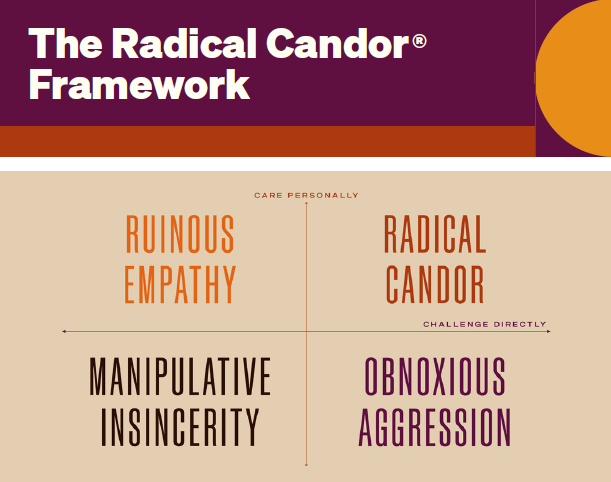
What is Radical Candor?

  1. Care personally → while engaging with others show how you care about their wellbeing/feelings as a person,

  2. Challenge directly → tell the good and the bad directly, do not overvalue the short-term feelings, but think about the long-term prospects.

A imagine can speak 1.000 words, thus the below framework will do just that:

This framework should be used to guide better discussions/conversations with others.

Share

The “Care Personally” dimension, aka “Give a Damn” dimension, makes us embrace the emotions embedded in every interaction, avoid a “friend vs. foe” mindset and allows us to disclose common human decency when dealing with others.

The “Challenge Directly” dimension oblige you to say what you think when things are not going well or to say something when they are and avoid the default mindset “if I cannot say something positive, I would not say a thing”.

You should not forget that providing Radical Candor is always about what you think and is not communicating a truth/fact of life. Why? Candor implies a dialogue, and you are not fully certain of your feedback and willing to receive counterarguments, while a truth is a one-way communicating path.

The key on how to approach Radical Candor it is not to make the other person feel good, but what would be good for them.

(WHY) One should not forget that is part of your job as manager to provide critical feedback, praise and also solicit feedback. Full Stop.

(HOW) In order to do the above you should:

  1. Get feedback,

  2. Give praise & criticism

  3. Gauge it - understand how it has landed

  4. Encourage it within your team.

    Share Risk Premium

(WHEN) if possible, it should be immediate, and one should not wait for a better moment, thus do not wait for your 1-2-1 or PDP, but you need to ensure that everyone, including yourself, is in the right mood/mindset and it should be quick and not something too lengthily.

Double-clicking on the 4 steps mentioned on the how, my key takeaways were:

  1. Ask and Receive feedback

Why we need it:

  • Understand what we are doing that is contributing to such behavior and good/poor performance,

  • Understand the context,

  • Provide psychological safety to the other person to speak its mind.

How to do-it:

  • Think the questions you will make to induce that feedback - (Start, Stop, Continue doing),

  • Make it natural and authentic,

  • Be aware on how your words are landing,

  • Do not fish for compliment,

  • Make open-ended questions, but within a context or situation you want to approach.

    Leave a comment

Remember that the goal is to detect if you are doing something wrong and how you can improve and actively listen to the feedback.

While listening embrace the discomfort, you should not be defensive and make follow-up questions.

Finally, you should reward candor. How?:

  • if you agree with the feedback, fix the problem immediately,

  • if you agree but it’s difficult to solve it quickly, acknowledge it and ask help to fix it,

  • if you disagree you should, with respect, explain why you disagree.

  1. Offer powerful praise

While praising you should:

  • focus on what went well,

  • show that you care and,

  • challenge that person to do more of that

The key features of a good praise have the following ingredients:

  • Should be helpful (humble),

  • Immediate and in person,

  • Public and not about personality but actions,

  • Context - you should provide a clear context,

  • Observation - pinpoint the specific action(s) that you are referring to,

  • Results - Provide the effect of such action,

  • Next steps - promote that it happens again.

  1. Give Criticism Effectively

The key features of effective criticism are exactly the same as #2, with the exception that it should be made privately.

One should offer criticism for things that really matter and are important to the receiver of the critique.

When that critique lands badly and too personal, try to focus the conversation on the behavior and not the person.

Subscribe now

Try to start a dialogue to promote corrections and for that one should:

  • not try to find winners or losers, but find a solution,

  • bring data to support the discussion,

  • try to understand the other side POV.

  1. Gauge how your feedback lands

Don’t forget it is a conversation, not a dialogue, understand how the other person is responding to what you are saying.

More often than not, such talks go better than you anticipated, but when your feedback is not being received as you wanted to, what can you do?

If they seem sad:

  • should avoid relaxing the challenge directly quadrant of your message, but you should step-up the care personally quadrant.

  • stay present and offer comfort,

  • ensure that you understand the emotion being shared,

  • see what is needed in that moment by the other person.

    Share

If they seem mad:

  • get curious not furious - be self-aware if the latter happens to control it,

  • go up a notch on the care personally axis,

  • try to think how you could have said it differently in order not to trigger that kind of reaction.

If they are not listening:

  • step-up on the challenge directly axis,

  • use multiple examples to draw attention,

  • ask for feedback on what you have said and what has been understood.

We should understand how hard to push, but we also need to know when we need to part way and you should promote a “Radical Candor” culture within your organization and/or teams.

As a conclusion, I do feel that I gained a lot by investing my time on this training and hopefully I will be able to use most of the insights and new knowledge in my day-2-day work, although for that it will require persistence and consistent practice.

Happy to discuss further about this subject with all that have interest in this topic.


from Risk Premium https://ift.tt/6wyVZ5k
via IFTTT

5/14/2024

The Theory and Practice of Enterprise AI 2nd edition - Book Recommendation

A book that was recommend by a dear colleague as a good reference for AI theory & practice. Definitely too advanced for me (maybe in a couple of years I can fully use it) but it seems it is highly practical, with use-cases that you can test & check in python. You can buy it or download in the below link. Hopefully it will be useful for some of you. Happy readings and practice. “….Advancements in deep learning, reinforcement learning, and generative AI have dramatically extended the toolkit of machine learning methods available to enterprise practitioners. This book provides a comprehensive guide to how marketing, supply chain, and production operations can be improved using these new methods, as well as their use in conjunction with traditional analytics and optimization approaches. The book is written for enterprise data scientists and analytics managers, and will also be useful for graduate students in operations research and applied statistics. The Theory and Practice of Enterprise AI is divided into five parts. Part I introduces the basic concepts of enterprise decision automation, deep learning, generative AI, and reinforcement learning methods. Part II presents recipes for customer analytics and personalization. Part III describes search, recommendations, knowledge management, and media generation solutions that are focused on content data such as texts and images. Part IV discusses methods for demand forecasting, price optimization, and inventory management. Finally, Part V presents blueprints for anomaly detection and visual inspection that help to improve production and transportation operations. Python code examples are provided in the complementary online repository to support the reader's understanding of the implementation details. …” https://www.enterprise-ai-book.com/

- Pedro

Read on Substack