5/18/2024

Una aurora boreal ilumina los cielos del mundo!

El pasado finde has podido presenciar una aurora boreal en algunas partes de España. Infelizmente yo no he podido verlo, pero en el link adjunto podrás ver algunas imágenes preciosas do que lo que se ha podido ver en todo el mundo. ¡Las auroras boreales son fenómenos que se pueden ver en regiones polares septentrionales, pero derivado de una gran tormenta geomagnética fruto de una actividad solar muy alta que solo pasa cada 10 a 12 años! ¡Disfrutad de las imágenes! https://elpais.com/ciencia/2024-05-11/una-aurora-boreal-ilumina-los-cielos-de-espana-y-podria-volver-a-ser-observable-este-fin-de-semana.html?autoplay=1

- Pedro

Read on Substack

5/17/2024

The silent flight of an owl - Natural World: Super Powered Owls

Nature at its best! How the flight of an owl does not produce any sound to a human ear and even the microphones detect a sound wave with an extremely low length/amplitude. Now the question is how they are able to be so silent? Something that I “need” to investigate https://youtu.be/-WigEGNnuTE?si=ZX0DXL8jdtc3HHL9

- Pedro

Read on Substack

5/16/2024

The Man Who Knew Infinity - Movie Recommendation

Great movie about the life of Srinivasa Ramanujan! Already heard a lot about him, but never knew his full story and it is something special to say the least. Highly recommend it. Hopefully you enjoy the movie as I did. https://youtu.be/LBvYjQvQB-k?si=uKVJSxmmK5NtTNoP https://www.primevideo.com/detail/0I5Q4TNZR7NVAN64CEEC1YZ3TD/ref=atv_dp_share_cu_r

- Pedro

Read on Substack

5/15/2024

Finalized Training -> Tackle the Hard Conversations with Radical Candor®

Finalized more than 1 month ago the MasterClass - Training with Kim Scott about Tackle the Hard Conversations with Radical Candor® (trailer below).

The more than 3 hours of content was a great investment and I have learnt a lot in an area that I definitely needed to improve my game.

I can only say that I really enjoyed the Sessions and made me think differently on how to tackle conversations throughout my personal and professional life (hard or soft), by following the 4 pillars of the Radical Candor framework:

  1. Get feedback,

  2. Give praise,

  3. Give criticism,

  4. Gauge on how the feedback has landed.

and while doing it, to be cognizant that the most important is not what you say, but what the receiving part understands.

Subscribe now

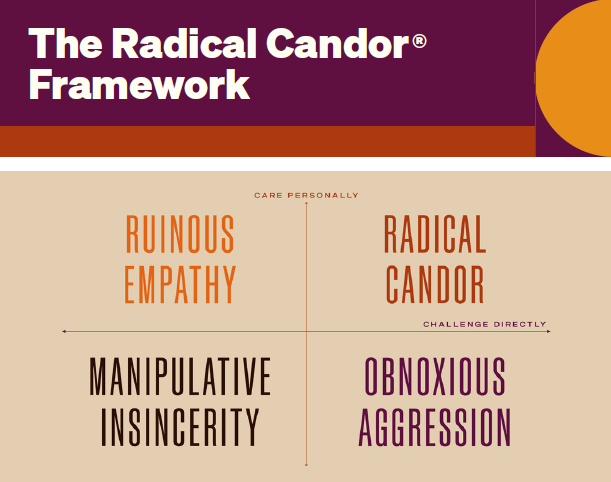
What is Radical Candor?

  1. Care personally → while engaging with others show how you care about their wellbeing/feelings as a person,

  2. Challenge directly → tell the good and the bad directly, do not overvalue the short-term feelings, but think about the long-term prospects.

A imagine can speak 1.000 words, thus the below framework will do just that:

This framework should be used to guide better discussions/conversations with others.

Share

The “Care Personally” dimension, aka “Give a Damn” dimension, makes us embrace the emotions embedded in every interaction, avoid a “friend vs. foe” mindset and allows us to disclose common human decency when dealing with others.

The “Challenge Directly” dimension oblige you to say what you think when things are not going well or to say something when they are and avoid the default mindset “if I cannot say something positive, I would not say a thing”.

You should not forget that providing Radical Candor is always about what you think and is not communicating a truth/fact of life. Why? Candor implies a dialogue, and you are not fully certain of your feedback and willing to receive counterarguments, while a truth is a one-way communicating path.

The key on how to approach Radical Candor it is not to make the other person feel good, but what would be good for them.

(WHY) One should not forget that is part of your job as manager to provide critical feedback, praise and also solicit feedback. Full Stop.

(HOW) In order to do the above you should:

  1. Get feedback,

  2. Give praise & criticism

  3. Gauge it - understand how it has landed

  4. Encourage it within your team.

    Share Risk Premium

(WHEN) if possible, it should be immediate, and one should not wait for a better moment, thus do not wait for your 1-2-1 or PDP, but you need to ensure that everyone, including yourself, is in the right mood/mindset and it should be quick and not something too lengthily.

Double-clicking on the 4 steps mentioned on the how, my key takeaways were:

  1. Ask and Receive feedback

Why we need it:

  • Understand what we are doing that is contributing to such behavior and good/poor performance,

  • Understand the context,

  • Provide psychological safety to the other person to speak its mind.

How to do-it:

  • Think the questions you will make to induce that feedback - (Start, Stop, Continue doing),

  • Make it natural and authentic,

  • Be aware on how your words are landing,

  • Do not fish for compliment,

  • Make open-ended questions, but within a context or situation you want to approach.

    Leave a comment

Remember that the goal is to detect if you are doing something wrong and how you can improve and actively listen to the feedback.

While listening embrace the discomfort, you should not be defensive and make follow-up questions.

Finally, you should reward candor. How?:

  • if you agree with the feedback, fix the problem immediately,

  • if you agree but it’s difficult to solve it quickly, acknowledge it and ask help to fix it,

  • if you disagree you should, with respect, explain why you disagree.

  1. Offer powerful praise

While praising you should:

  • focus on what went well,

  • show that you care and,

  • challenge that person to do more of that

The key features of a good praise have the following ingredients:

  • Should be helpful (humble),

  • Immediate and in person,

  • Public and not about personality but actions,

  • Context - you should provide a clear context,

  • Observation - pinpoint the specific action(s) that you are referring to,

  • Results - Provide the effect of such action,

  • Next steps - promote that it happens again.

  1. Give Criticism Effectively

The key features of effective criticism are exactly the same as #2, with the exception that it should be made privately.

One should offer criticism for things that really matter and are important to the receiver of the critique.

When that critique lands badly and too personal, try to focus the conversation on the behavior and not the person.

Subscribe now

Try to start a dialogue to promote corrections and for that one should:

  • not try to find winners or losers, but find a solution,

  • bring data to support the discussion,

  • try to understand the other side POV.

  1. Gauge how your feedback lands

Don’t forget it is a conversation, not a dialogue, understand how the other person is responding to what you are saying.

More often than not, such talks go better than you anticipated, but when your feedback is not being received as you wanted to, what can you do?

If they seem sad:

  • should avoid relaxing the challenge directly quadrant of your message, but you should step-up the care personally quadrant.

  • stay present and offer comfort,

  • ensure that you understand the emotion being shared,

  • see what is needed in that moment by the other person.

    Share

If they seem mad:

  • get curious not furious - be self-aware if the latter happens to control it,

  • go up a notch on the care personally axis,

  • try to think how you could have said it differently in order not to trigger that kind of reaction.

If they are not listening:

  • step-up on the challenge directly axis,

  • use multiple examples to draw attention,

  • ask for feedback on what you have said and what has been understood.

We should understand how hard to push, but we also need to know when we need to part way and you should promote a “Radical Candor” culture within your organization and/or teams.

As a conclusion, I do feel that I gained a lot by investing my time on this training and hopefully I will be able to use most of the insights and new knowledge in my day-2-day work, although for that it will require persistence and consistent practice.

Happy to discuss further about this subject with all that have interest in this topic.


from Risk Premium https://ift.tt/6wyVZ5k
via IFTTT

5/14/2024

The Theory and Practice of Enterprise AI 2nd edition - Book Recommendation

A book that was recommend by a dear colleague as a good reference for AI theory & practice. Definitely too advanced for me (maybe in a couple of years I can fully use it) but it seems it is highly practical, with use-cases that you can test & check in python. You can buy it or download in the below link. Hopefully it will be useful for some of you. Happy readings and practice. “….Advancements in deep learning, reinforcement learning, and generative AI have dramatically extended the toolkit of machine learning methods available to enterprise practitioners. This book provides a comprehensive guide to how marketing, supply chain, and production operations can be improved using these new methods, as well as their use in conjunction with traditional analytics and optimization approaches. The book is written for enterprise data scientists and analytics managers, and will also be useful for graduate students in operations research and applied statistics. The Theory and Practice of Enterprise AI is divided into five parts. Part I introduces the basic concepts of enterprise decision automation, deep learning, generative AI, and reinforcement learning methods. Part II presents recipes for customer analytics and personalization. Part III describes search, recommendations, knowledge management, and media generation solutions that are focused on content data such as texts and images. Part IV discusses methods for demand forecasting, price optimization, and inventory management. Finally, Part V presents blueprints for anomaly detection and visual inspection that help to improve production and transportation operations. Python code examples are provided in the complementary online repository to support the reader's understanding of the implementation details. …” https://www.enterprise-ai-book.com/

- Pedro

Read on Substack

5/13/2024

Putting Theory into Practice with Bill Gurley & Michael Mauboussin - highly recommend this podcast

Pleasantly surprised with this podcast with Bill Gurley and Michael Mauboussin. Will definitely follow them from now on. More than a couple of great insights that I got to myself: AI is sustained or disruptive innovation? looks more sustained as it is coming mainly from the incumbents (non-LLMs AI) and they are not getting their eyes from the ball. One should separate AI and LLMs, look like different beasts. New technology and how it impacts companies: 1st wave → helps productivity and efficiency 2nd wave → its embedded in the daily operations and changes how companies work and generate value. How can you increase the margin utility of your customers via network effect or others is paramount to your business The importance of strengthen your WTP and WTS (economies of scale) and then you can capture it via pricing (or you increase the consumer surplus). Pricing power is not the key issue in a company profitability or valuation, instead is if the WTP is increasing every single day to the customer, as Pricing Power is just a derivative of the WTP function (see image below on Value-Based Strategy by Brandenburger and Stuart). Recombination of ideas framework and its importance - how to manipulate the inputs of a production function, mainly on technology & ideas, the residual on the Solow’s economic model, that allows to have a greater output. The number of public companies has shrunk significantly (46%), Would need what is the comparison period. Wright's law to predict cost dynamic →says that for every doubling of cumulative output, your cost per unit goes down by 20% Since 1926 60% of public companies could not earn at least treasury bill rates! 2% of public companies generated 90% of the total value generated in market! My guests today are Bill Gurley and Michael Mauboussin. Bill is a General Partner at Benchmark, and Michael is the Head of Consilient Research for Counterpoint Global. While they are longtime friends with one another, I’d never heard them appear somewhere together so it was a real treat to be able to do this with the two of them. They are two of the leading minds in their fields, and we combined their decades of expertise into one wide-ranging conversation. We discuss the different kinds of increasing returns to scale, the issue of regulatory capture, AI, and hardware. Please enjoy this great conversation with Bill Gurley and Michael Mauboussin. https://podcasts.apple.com/es/podcast/invest-like-the-best-with-patrick-oshaughnessy/id1154105909?i=1000653305035

- Pedro

Read on Substack

5/12/2024

Starting -> The Secret Language of Competitive Intelligence: How to See Through and Stay Ahead of Business Disruptions, Distortions, Rumors, and Smoke Screens → Leonard M. Fuld

Starting a new book! The Secret Language of Competitive Intelligence: How to See Through and Stay Ahead of Business Disruptions, Distortions, Rumors, and Smoke Screens → Leonard M. Fuld Explains how to anticipate future competitive threats in order to make prudent business decisions, with helpful advice on how to extract key bits of information from the Internet and other sources, how to verify the accuracy of data, and how to transform raw data into effective, market-based decisions. https://www.goodreads.com/book/show/9875213-the-secret-language-of-competitive-intelligence?ac=1&from_search=true&qid=ybLU0dmhe5&rank=2

- Pedro

Read on Substack