
Separating the CEO from the hand they were dealt
A new Claude Code skill that grades any public-company CEO on what is theirs, plus ten anonymized cases to show it working.
I have been having a lot of fun building skills in Claude Code lately. A skill is just a packaged set of instructions and tools that teaches the model to do one thing well and repeatably. Once it exists, I can point it at a new input and get the same structured output every time, without rebuilding the logic by hand.
The latest one grades CEOs. Give it any public-company chief executive and it returns the same disciplined read: a setup, a scorecard, two composite scores, and a verdict.
The problem it fixes
Most CEO commentary is captured by the company’s own narrative. Management foregrounds the metrics it hit and quietly reframes the ones it missed. Headline results get flattered by cyclical tailwinds, by one-time items, by recovery off a depressed base, and by the execution of a strategy that someone else designed. Read enough earnings calls and you start scoring the press release rather than the person.
The skill is built to refuse that. It strips the headline back to what is attributable to the CEO. It credits real value-add fully, and declines to credit luck, inertia, or accounting noise.
How it works
The conceptual core is two measures that look similar and are not.
The first is the delta from baseline. I score the company’s qualitative state at handover, then again today, and take the difference. It answers a narrow question: does the company look better or worse than when this person took over? Useful as a sanity check. Not a measurement of value creation.
The second is the residual. It asks whether the CEO beat a peer-median replacement holding the same hand, over the same calendar window. Actual performance minus expected performance, where expected is what a competent peer would have delivered with the same inheritance in the same cycle. This is the number that matters, because it controls for both the cycle and the hand.
The two often disagree, and the disagreement is the interesting part. A CEO can post a positive delta and a deeply negative residual: the company looks better on paper, yet lagged every peer in the same cycle. The reverse happens too. A steward can inherit a near-perfect franchise, watch the qualitative score barely move, post a slightly negative delta, and still compound far ahead of the sector. Positive residual, negative delta. The franchise does the work, and the question becomes whether the leader added anything on top of it.
Around those two measures sits the machinery: a thirteen-dimension scorecard running from strategic vision to succession quality, and four adjustment disciplines that separate recurring from one-time, cyclical from structural, inherited from originated, and input metrics from output metrics. There are a couple of hard rules I cannot override. An ouster under cause caps the governance score. Only an originated, non-consensus vision earns a 9 or a 10, which keeps the top of the scale honest.
The whole thing is built to fight my own bias toward a generous 7. Most CEOs, in most tenures, land at 4 to 6 once the rigor is applied evenly.
Ten cases, no names
To show the framework working without grading anyone by name, I ran ten anonymized cases across industries, from semiconductors to media and entertainment. The industry stays visible. The identity does not. Anonymizing also lets me publish it freely and let the method speak rather than the personalities.
The spread runs from 2.8 to 8.8, and the ordering is clean rather than collapsing into a noncommittal middle.
Founder-originators sit at the top. They built the position the company holds, so the cycle helped them but did not create them. There is also a hired CEO near the top, which matters: the high marks are not reserved for founders, they are reserved for originated theses, and a non-founder who originates a winning, non-consensus strategy earns the same credit.
Value-destroyers ousted under cause sit at the bottom, where a high inherited baseline makes the destruction worse, not better, because the head start was squandered.
The most useful finding sits in the middle. The framework is consistently harsher than sell-side on competent operators of inherited premium franchises, and it refuses to read a cyclical recovery as skill. The market prices the franchise and the rebound. The framework grades the leader. Both views are defensible, and the gap between them is exactly the signal worth surfacing
.
What it cannot do
A note on honesty, because a framework that pretends to see everything is worse than useless. This one scores observable performance. It cannot detect undisclosed fraud, hidden accounting irregularities, or operational misbehavior that has not surfaced yet. When I tested it against historical cases where the outcome is now known, four matched cleanly and one only partially: the executive who looked strong right up until a concealed scandal broke. That case is the blind spot, and it is a standing reminder to pair this kind of scorecard with separate fraud-and-governance diligence rather than treat the composite as the whole picture.
The point
The point is not to dunk on chief executives. It is to keep score in a way that survives the disciplines, that treats a turnaround CEO and a fortress steward by the same rules, and that answers the only question worth asking: who created value relative to the hand they were dealt, rather than whose company has the nicer headline.
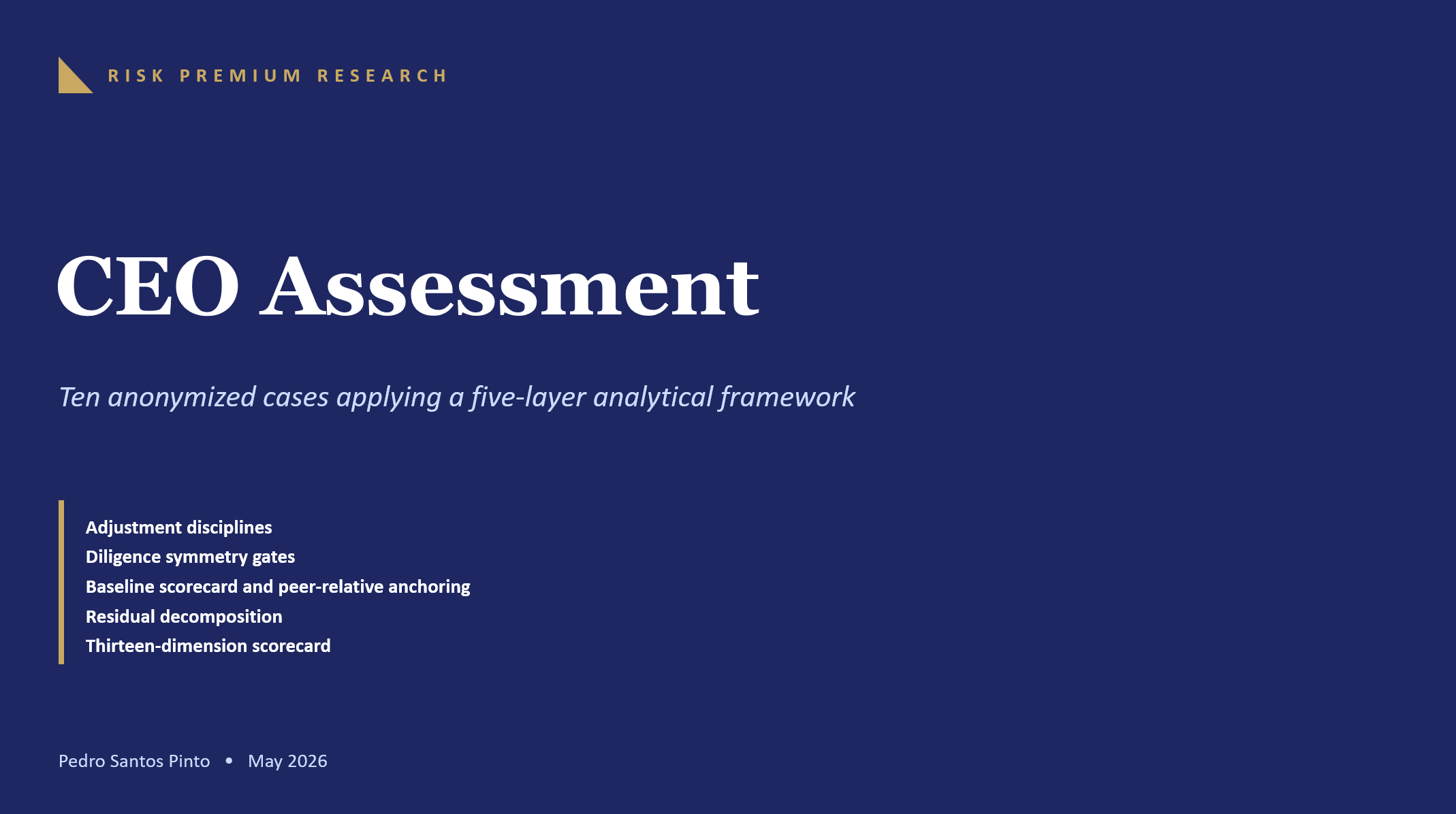
The full ten-case deck is below. Built, as ever, with a fair amount of fun, in Claude Code.
This is published for informational and educational purposes only. It is not investment advice, nor a recommendation, offer, or solicitation. The cases are illustrative and anonymized; no company or individual is named, and any identification a reader infers is the reader’s own. Views are my own, current only as of the date shown, and may change. Past performance is not indicative of future results. Do your own research.
from Risk Premium https://ift.tt/huArlU5
via IFTTT

No comments:
Post a Comment