A great article from the Economist and a must read for all Data professionals.


A great article from the Economist and a must read for all Data professionals.
Must read → Review to come shortly!

"...Getting to Yes has helped millions of people learn a better way to negotiate. One of the primary business texts of the modern era, it is based on the work of the Harvard Negotiation Project, a group that deals with all levels of negotiation and conflict resolution.

On how to differentiate the signal and the noise

ps - book added to the wish list.
My guest today is Brad Jacobs. Brad’s resumé is remarkable. He has founded seven companies, all of which are billion-dollar or multibillion-dollar businesses. He has done 500 M&A transactions and raised $30 billion dollars of debt and equity capital. Currently, he is the Executive Chairman of XPO, a commercial trucking company that he started in 2011 and has grown into one of the largest logistics businesses in the world. He has also written a book that will be out in January, titled “How to Make a Few Billion Dollars”. Brad’s energy is infectious and our conversation unpacks his strategies for M&A, his propensity for speed, and methods for earning team buy-in. Please enjoy my conversation with Brad Jacobs.
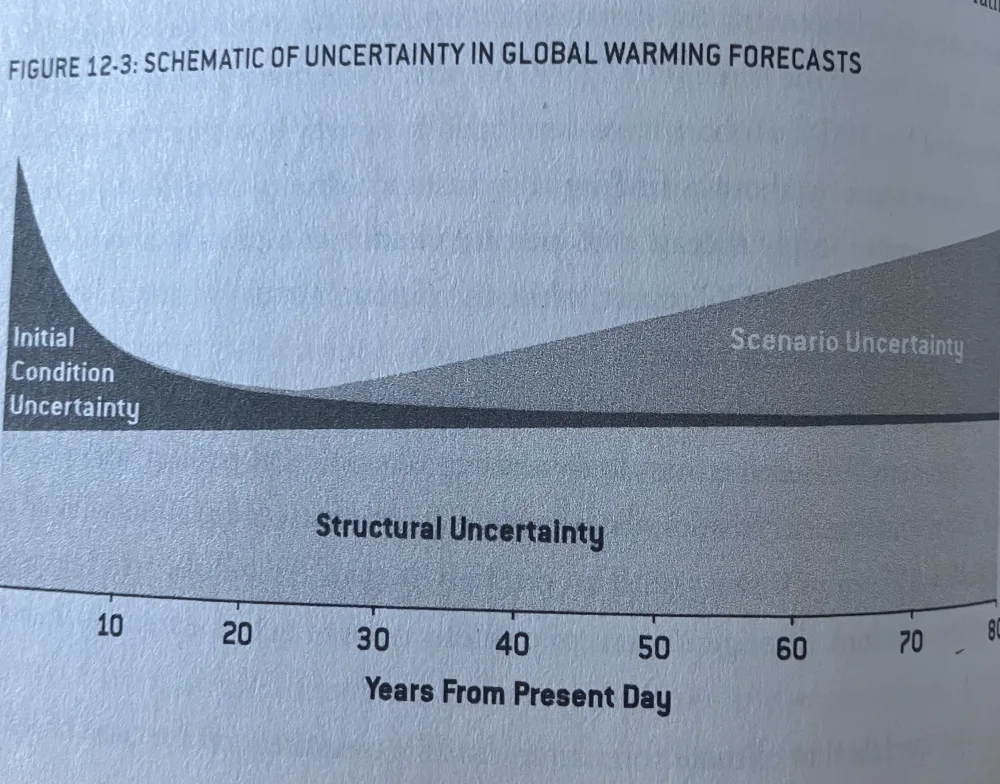
3 types of Uncertainty in Forecasts - using Global Warming as an example.
First, there is what Schmidt calls initial condition uncertainty-the short-term factors that compete with the greenhouse signal and impact the way we experience the climate. The greenhouse effect is a long-term phenomenon, and it may be obscured by all types of events on a day-to-day or year-to-year basis.
-----------------------------------------------------------------------------------------------------
Another type of uncertainty, however-what Schmidt calls scenario uncertainty- increases with time. This concerns the level of CO, and other greenhouse gases in the atmosphere. At near time horizons, atmospheric composition is quite predictable. The level of industrial activity is fairly constant, but CO, circulates quickly into the atmosphere and remains there for a long time. (Its chemical half-life has been estimated at about thirty years)
Last, there is the structural uncertainty in the models. This is the type of uncertainty that both climate scientists and their critics are rightly most worried about, because it is the most challenging to quantify. It concerns how well we understand the dynamics of the climate system and how well we can represent them mathematically. Structural uncertainty might increase slightly over time, and errors can be self-reinforcing in a model of a dynamic system like the climate.
On economic forecasting and pure statistical forecasts vs. modeling/simulation forecasts
The goal of any predictive model is to capture as much signal as and as little noise as possible. Striking the right balance is not always and our ability to do so will be dictated by the strength of the theory quality and quantity of the data. In economic forecasting, the data is and the theory is weak, hence Armstrong's argument that "the more you make the model the worse the forecast gets."
In fact, up until about thirty years ago, purely statistical models were the primary way that the weather service forecasted hurricane trajectories.
Such techniques, however, are subject to diminishing returns. Hurricanes are not exactly rare, but severe storms hit the United States perhaps once every year on average. Whenever you have a large number of candidate variables applied to a rarely occurring phenomenon, there is the risk of overfitting your model and mistaking the noise in the past data for a signal.
This second type of model essentially creates a simulation of the physical mechanics of some portion of the universe. It takes much more work to build than a purely statistical method and requires a more solid understanding of the root causes of the phenomenon.